

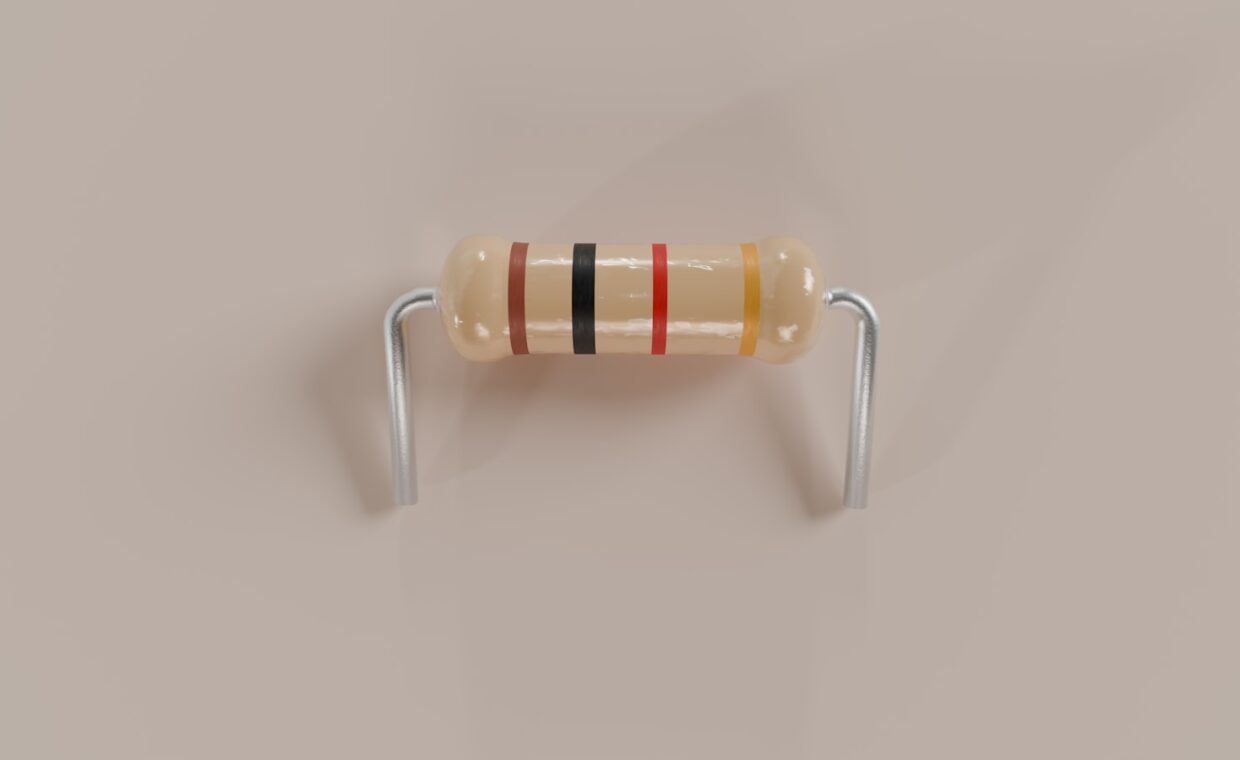
Those small cylindrical resistors in every electronics kit carry their value in a ring of colored bands rather than printed numbers, and to a newcomer the code looks arbitrary. It is not. Each color stands for a digit, and the bands follow a fixed order that spells out a resistance in ohms along with how accurate that figure is. Once you learn the pattern you can read almost any resistor by eye in a few seconds. This walkthrough covers what the colors mean, how to read four-band and five-band parts in order, and how to confirm the result with a meter.
What the colors stand for
The system rests on a single idea: each color is a number. Black is 0, brown is 1, red is 2, and so on up to white at 9, following the order of the spectrum with black and brown added at the start. The same colors do three different jobs depending on where they sit in the sequence. Some bands supply digits, one band acts as a multiplier, and a final band states the tolerance, meaning how far the real value may stray from the marked one.
Learning the color-to-digit table is the one piece of memorising involved, and it repays the effort every time you pick up a resistor. Many people fix the order with a mnemonic. The table below lists the value each color carries in a digit position, the multiplier it represents, and the tolerance it marks where relevant.
| Color | Digit | Multiplier | Tolerance |
|---|---|---|---|
| Black | 0 | x1 | none |
| Brown | 1 | x10 | 1% |
| Red | 2 | x100 | 2% |
| Green | 5 | x100,000 | 0.5% |
| Gold | none | x0.1 | 5% |
| Silver | none | x0.01 | 10% |
Reading the bands in order
Reading a resistor means taking the bands left to right from the correct starting end, then applying each band’s job. The steps below work for both the common four-band parts and the more precise five-band ones.
- Orient the resistor so the grouped bands sit on the left and the single, slightly separated band sits on the right. That lone band is the tolerance and is read last.
- Read the first two bands on a four-band resistor, or the first three on a five-band one, as digits, writing them down in order.
- Read the next band as the multiplier, the power of ten you multiply the digits by.
- Read the final band as the tolerance, the percentage by which the true value may vary.
- Combine the digits, apply the multiplier, and note the tolerance to state the full value in ohms.
The only difference between the two types is how many digit bands come first. A four-band resistor gives two significant digits, while a five-band resistor gives three for finer values. Parts like these sit in almost every beginner circuit, including the wiring described in the primer on a small computer’s input and output pins.
Working out the multiplier and tolerance
The multiplier is where beginners most often slip. It is not an extra digit but a scale: a red multiplier band means multiply by 100, a black one means multiply by one, and gold means multiply by 0.1 for small values. So a four-band resistor reading brown, black, red gives the digits 1 and 0, multiplied by 100, which is 1,000 ohms, or one kilohm. Writing the digits first and applying the scale second keeps the process reliable.
Tolerance tells you how much trust to place in that figure. A gold band means the real value falls within 5 percent, and brown means within 1 percent. For a nominal 1,000 ohm part at 5 percent, the actual resistance may sit anywhere from 950 to 1,050 ohms. That margin matters when a resistor protects a sensitive pin, a job explained in the piece on keeping signal voltages within safe limits, where a value that drifts too far could pass more current than intended.
Confirming with a multimeter
Colored bands fade, and dark shades like brown, red and black are easy to confuse under poor light, so a meter is the honest check. Set a multimeter to resistance mode, touch one probe to each leg of the resistor, and read the value on the display. The resistor should be out of the circuit, or at least unpowered, because surrounding components can pull the reading off.
Expect the measured figure to fall within the tolerance band, not to match the marked value exactly. A 4,700 ohm resistor might read 4,650, which is comfortably inside a 5 percent margin and perfectly fine. A meter check is especially reassuring when you are wiring up a sensor, as in the walkthrough on taking readings with a tiny computer, where an unexpected resistance can quietly distort the numbers you collect.
Edge cases worth knowing
A few resistors break the simple four-band and five-band pattern. Parts with only three bands have no tolerance band, which by convention means a loose 20 percent. Six-band resistors add a final band for temperature coefficient, describing how the value shifts as the part heats up, which matters only in precise designs. When both ends look similar and you cannot spot the tolerance gap, the meter settles the reading direction faster than guessing.
Building the habit
Reading color codes feels slow at first and becomes automatic sooner than most people expect. The digit order is the only thing to commit to memory; everything else is applying the multiplier and noting the tolerance. Keeping a printed color chart on the bench for the first few sessions bridges the gap while the sequence settles in, and reaching for the meter whenever a band is ambiguous saves rebuilding a circuit later.
The skill earns its place the moment you start sorting a mixed bag of resistors or following a wiring diagram, such as a first build described in the overview of choosing a starter electronics board. Being able to pick the right value by eye, then verify it in seconds, turns a jumble of look-alike parts into an organised, usable set and keeps your circuits behaving the way the design intended.
What readers often ask
Which end of a resistor do I read first?
Start from the end where the bands sit grouped closest together. The tolerance band stands slightly apart from the rest, usually with a small gap, and belongs at the far right as the last band you read. If the spacing is hard to judge, look for gold or silver, which almost always marks the tolerance and therefore the finishing end, not the start.
What does the gold or silver band mean?
In the final position, gold and silver state tolerance: gold is 5 percent and silver is 10 percent, the two most common grades. In the rarer multiplier position they act as fractional scales instead, gold multiplying by 0.1 and silver by 0.01 for resistances below ten ohms. Their usual job on a hobby resistor is marking how far the true value may vary.
How do I read a 5-band resistor?
Treat the first three bands as digits rather than two, then the fourth as the multiplier and the fifth as the tolerance. The extra digit gives a more precise value, which is why five-band parts suit tighter tolerances. So red, violet, black, brown reads as the digits 2, 7 and 0, multiplied by ten, giving 2,700 ohms at the marked tolerance.